 KitGuru KitGuru.net – Tech News | Hardware News | Hardware Reviews | IOS | Mobile | Gaming | Graphics Cards


Following the reveal of its flagship RTX 5090 external GPU at Computex, Gigabyte is now expanding its lineup with a more mainstream and affordable option. The company has today announced the Aorus RTX 5060 Ti AI Box, a compact eGPU designed to bring desktop-class gaming and AI performance to thin-and-light laptops.
Inside the compact enclosure of Gigabyte's new Aorus RTX 5060 Ti AI Box is a desktop-class GeForce RTX 5060 Ti with 16GB of VRAM. To keep temperatures in check within its compact enclosure, Gigabyte has equipped it with a custom, dual-fan Windforce cooling solution, which should ensure a stable operation under load. Although Gigabyte didn't share any measurements for the AI Box, it appears to be considerably smaller than most alternatives, making it much easier to transport if desired.
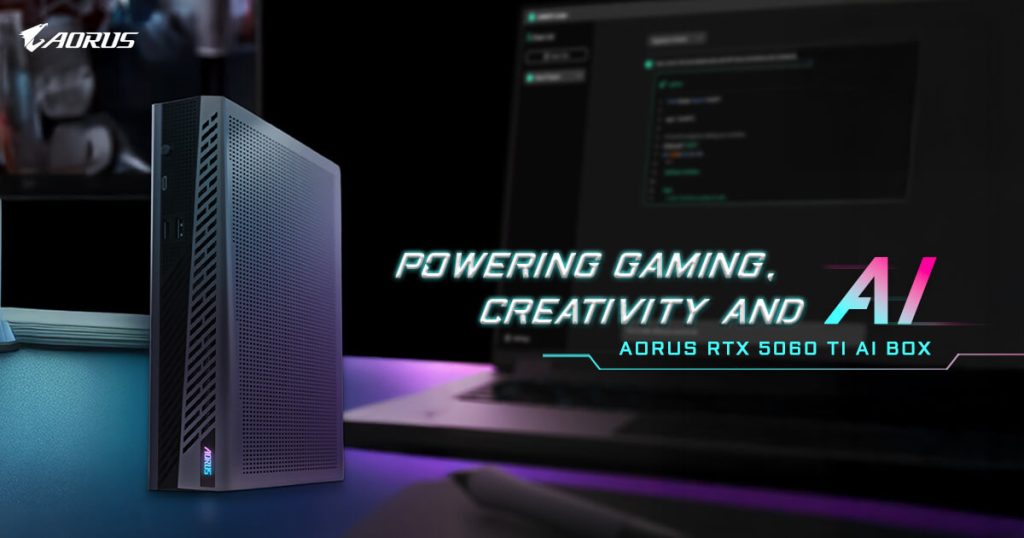
The AI Box connects to a laptop via either Thunderbolt 5 or USB4. Gigabyte is making a bold claim about this connection, stating that users should only experience a 5% performance difference compared to running the same RTX 5060 Ti internally in a desktop PC. If true, this would be a significant step forward for eGPU performance, transforming ultrabooks into capable hybrid systems for gaming and 3D rendering.
In the same announcement, Gigabyte also confirmed that its flagship Aorus RTX 5090 AI Box is now officially available for purchase in various regions.
KitGuru says: Would you trade the performance offered by the RTX 5090 AI Box for the portability of the RTX 5060 Ti AI Box?