 KitGuru KitGuru.net – Tech News | Hardware News | Hardware Reviews | IOS | Mobile | Gaming | Graphics Cards


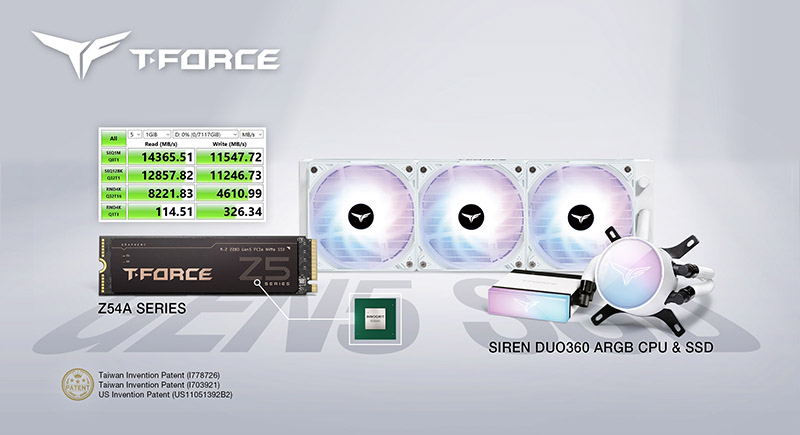
T-Force, the gaming brand of TeamGroup, has introduced its cutting-edge Z54A series, a new generation of PCIe Gen 5 SSDs that can push the standard's maximum read and write speeds. TeamGroup has collaborated exclusively with InnoGrit Corporation, a leading storage supplier, to develop these ultra-fast PCIe SSDs.
By collaborating with InnoGrit, T-Force has adopted the 12nm PCIe IG5666 controller for their Gen 5 SSDs. This controller boasts high performance, reliability, stability, and low latency, supporting a wide range of mainstream NAND speeds up to 2,400 MT/s. Thanks to the improved controller, the Z54A SSD can reach sequential read and write speeds of up to 14,000 MB/s and 10,000 MB/s, respectively.
The controller also incorporates a pioneering code-correction technique that extends the lifespan of NAND memory. Moreover, it features an AI algorithm to collect temperature data and a low-power mode decoder that can automatically switch to a power-saving mode to ensure sustained data integrity and longevity.
To address the thermal challenges associated with high-speed Gen 5 PCIe SSDs, T-Force provides a comprehensive range of heat sink solutions specifically designed for M.2 SSDs. The company's circular All-in-One (AIO) liquid cooling system offers an effective solution to the issue.
KitGuru says: T-Force's Z54A series is one of the fastest PCIe 5.0 SSDs announced to date. However, that will come at a cost, not just in higher prices, but also in higher temperatures that you'll need to accommodate for in your build.