 KitGuru KitGuru.net – Tech News | Hardware News | Hardware Reviews | IOS | Mobile | Gaming | Graphics Cards


Gigabyte has recently rolled out a new beta BIOS for all Z790 and B760 motherboards. This BIOS update allows users to disable the CEP (Current Excursion Protection) on Intel 14th, 13th, and 12th Gen Core series, increasing CPU performance while maintaining lower temperatures and stability.
Previously, the CEP feature on Intel's B760 chipset was always activated by default for all supported CPUs, and users couldn't disable it. However, the new beta BIOS allows you to disable CEP using Intel's revised microcode. Furthermore, the new BIOS optimises power settings for each CPU and includes PerfDrive, allowing for more balanced performance, power consumption, and temperature on the CPU.
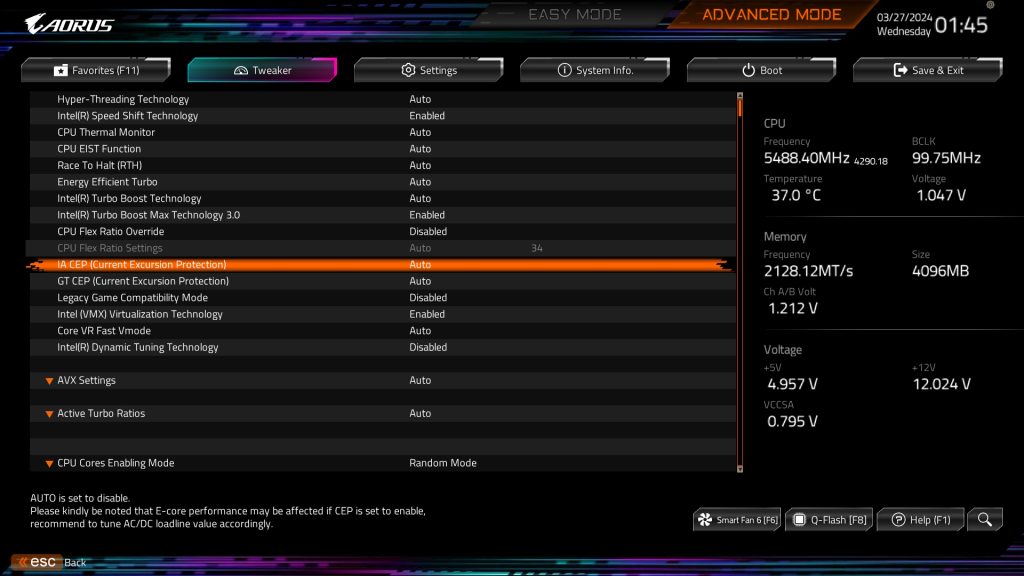
Test results have shown that the CPU and VRM temperatures have improved significantly while maintaining the same performance during periods of intense demand. In an example given by Gigabyte, using the B760M Aorus Elite AX, CPUs had temperature reductions of over 16º C compared to the prior BIOS.
The following table shows what CPUs support disabling CEP, given the motherboard and BIOS used:
| BIOS version | Previous BIOS | New BETA BIOS | ||
| CPU | 14th GEN K SKU | 14th GEN Non-K SKU | 14th GEN K SKU | 14th GEN Non-K SKU |
| Z790 motherboard | Yes | No | Yes | Yes |
| B760 motherboard | No | No | Yes | Yes |
KitGuru says: Do you own a Gigabyte Z790 or B760 motherboard? Will you update the BIOS to try disabling CEP, or are you good with your current settings?