 KitGuru KitGuru.net – Tech News | Hardware News | Hardware Reviews | IOS | Mobile | Gaming | Graphics Cards


Here we present the average clock speed for each graphics card while running the 3DMark Time Spy stress test for 30 minutes. We use GPU-Z to record the GPU core frequency during the Time Spy runs. We calculate the average core frequency during the 30 minute run to present here.
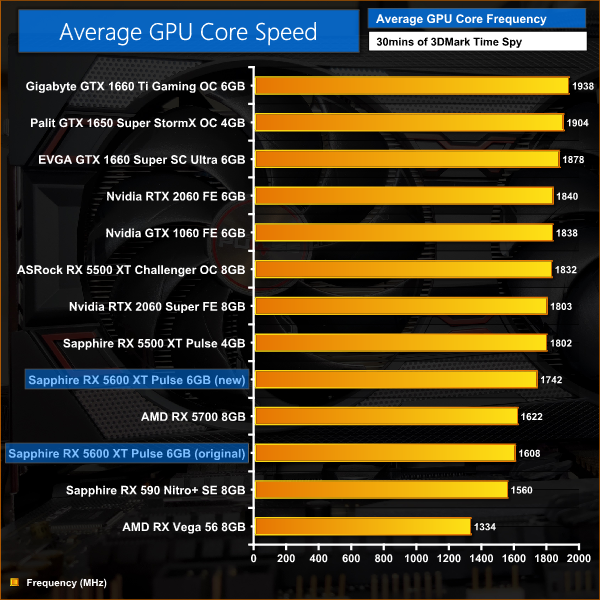
Here we can see a fascinating breakdown of the difference in core frequencies between the original, reference BIOS, and the updated one. When testing the original BIOS, we observed an average operating frequency of 1608MHz for the Pulse, which is above the 1560MHz game clock but just below the 1620MHz boost clock.
Once the BIOS was updated, frequency rose considerably – up to 1742MHz, which is a 134MHz increase, or 8%. This actually takes the 5600 XT beyond the RX 5700 in terms of GPU clock speed – before the update landed, I think you could see AMD trying to protect the 5700's position by launching the 5600 XT with lower speeds, but now it seems to me that thinking has changed.